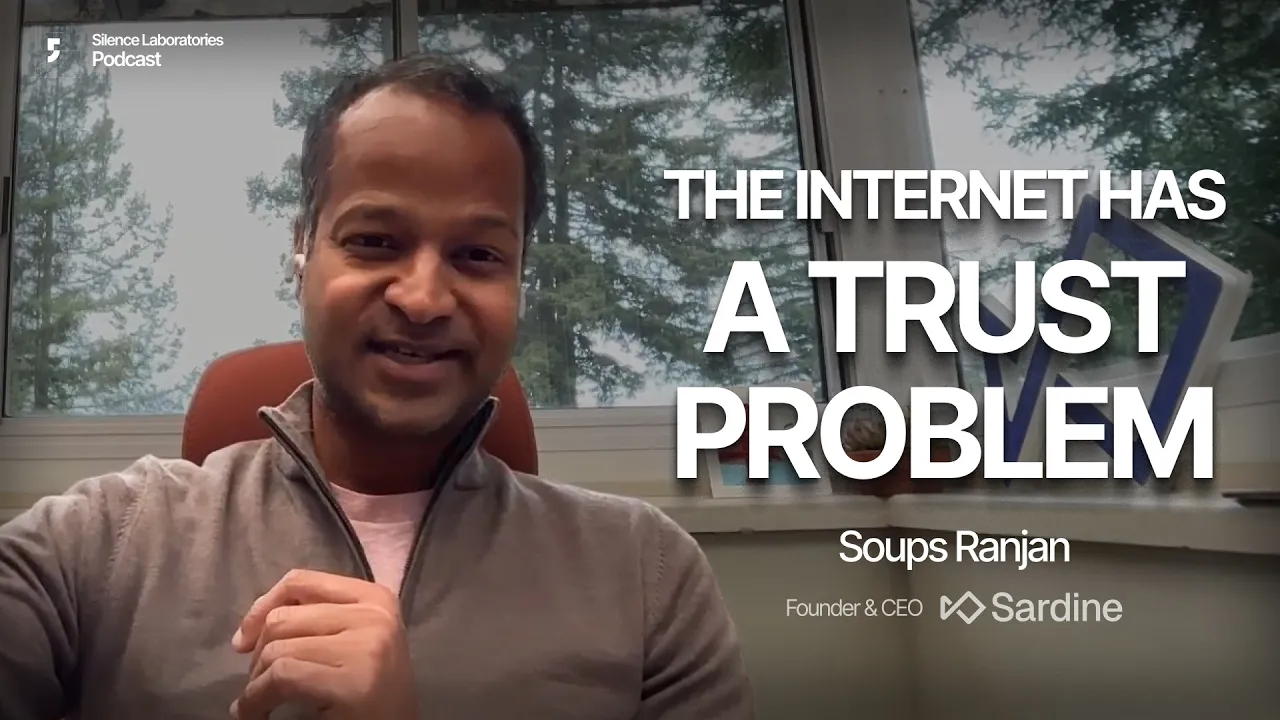
AI Agents, Online Fraud & the Human Behind the Transaction

AI Agents, Online Fraud & the Human Behind the Transaction

Buying through an AI agent changes what a merchant can see about the person making a purchase. It also creates opportunities for fraud that may be hard for the buyer to notice, even when the order arrives as expected.

Jay Prakash speaks with Soups Ranjan, co-founder and CEO of Sardine, about how fraud prevention is adapting to agentic commerce. Drawing on his work at Coinbase, Revolut and Sardine, Soups explains how device and behavioural signals help fraud teams assess what happens between opening an account and making a payment.

He shares an investigation in which an AI agent helped connect accounts opened with deepfakes to a wider fraud ring. The conversation then turns to shopping agents: why legitimate purchases get blocked, how merchants can learn more about the human behind an agent, and why following a customer’s instructions does not necessarily make a transaction safe.

Jay and Soups also discuss how specialised agents work together on investigations, the incentives that encourage competitors to share fraud intelligence, and why improving security requires attention to both fraud losses and the experience of genuine customers.

What you’ll hear in this episode

  • Soups’ journey from cybersecurity research to fraud prevention at Coinbase, Revolut and Sardine.

  • How application timing, typing behaviour and device signals help identify stolen or synthetic identities.

  • An investigation where an AI agent wrote SQL queries and traced connections between suspected fraud cases.

  • Why shopping agents can resemble malicious bots, and how Sardine’s “Know Your Human” approach provides additional context.

  • How triangulation fraud can leave a buyer with the goods they ordered while exposing their card details.

  • The difference between identifying an agent and understanding what it does after receiving access.

  • How Sardine combines specialised agents to investigate transactions and recommend fraud rules.

  • Sonar’s approach to sharing fraud intelligence, and why participation depends on workable incentives.

  • Soups’ outlook on AI’s role in finding vulnerabilities and the unresolved problem of knowing who is behind a message or transaction.

You should listen to this episode if you

  • Work in fraud prevention, financial crime, payments or digital identity.

  • Build AI agents that shop, make payments or act on someone else’s behalf.

  • Lead security, risk or product teams balancing fraud controls with customer experience.

  • Are exploring collaboration between institutions that hold different pieces of the same fraud investigation.

  • Want to understand how AI agents are already being used inside fraud operations.

Episode notes

Key Takeaways

Final Takeaway

Customer

Soups Ranjan

Co-founder & CEO, Sardine

Soups Ranjan leads Sardine, a platform for fraud prevention and financial crime management. Before founding the company, he led financial crime work at Revolut and risk at Coinbase. He holds a PhD in Electrical and Computer Engineering from Rice University, where his research focused on protecting web services against denial-of-service attacks. His work brings together machine learning, cybersecurity and the practical challenges of detecting fraud. Connect with Soups · Explore Sardine

AI Agents, Online Fraud & the Human Behind the Transaction

Buying through an AI agent changes what a merchant can see about the person making a purchase. It also creates opportunities for fraud that may be hard for the buyer to notice, even when the order arrives as expected.

Jay Prakash speaks with Soups Ranjan, co-founder and CEO of Sardine, about how fraud prevention is adapting to agentic commerce. Drawing on his work at Coinbase, Revolut and Sardine, Soups explains how device and behavioural signals help fraud teams assess what happens between opening an account and making a payment.

He shares an investigation in which an AI agent helped connect accounts opened with deepfakes to a wider fraud ring. The conversation then turns to shopping agents: why legitimate purchases get blocked, how merchants can learn more about the human behind an agent, and why following a customer’s instructions does not necessarily make a transaction safe.

Jay and Soups also discuss how specialised agents work together on investigations, the incentives that encourage competitors to share fraud intelligence, and why improving security requires attention to both fraud losses and the experience of genuine customers.

What you’ll hear in this episode

  • Soups’ journey from cybersecurity research to fraud prevention at Coinbase, Revolut and Sardine.

  • How application timing, typing behaviour and device signals help identify stolen or synthetic identities.

  • An investigation where an AI agent wrote SQL queries and traced connections between suspected fraud cases.

  • Why shopping agents can resemble malicious bots, and how Sardine’s “Know Your Human” approach provides additional context.

  • How triangulation fraud can leave a buyer with the goods they ordered while exposing their card details.

  • The difference between identifying an agent and understanding what it does after receiving access.

  • How Sardine combines specialised agents to investigate transactions and recommend fraud rules.

  • Sonar’s approach to sharing fraud intelligence, and why participation depends on workable incentives.

  • Soups’ outlook on AI’s role in finding vulnerabilities and the unresolved problem of knowing who is behind a message or transaction.

You should listen to this episode if you

  • Work in fraud prevention, financial crime, payments or digital identity.

  • Build AI agents that shop, make payments or act on someone else’s behalf.

  • Lead security, risk or product teams balancing fraud controls with customer experience.

  • Are exploring collaboration between institutions that hold different pieces of the same fraud investigation.

  • Want to understand how AI agents are already being used inside fraud operations.

HOST

Customer

Jay Prakash

Co-founder & CEO, Silence Laboratories

GUESTS

Customer

Soups Ranjan

Founder & CEO, Sardine

SHARE

More episodes