Private Fuzzy De-Duplication
How CCVM enables privacy-preserving fuzzy deduplication and entity resolution across encrypted datasets for fraud, AML, and analytics.

Written by
Kush Kanwar
Insights
Aug 4, 2026

Deduplication and entity resolution sit at the heart of almost every serious data problem: figuring out that "Jonathan A. Smith", "Jon Smith", and "J Smith" at three slightly different addresses are the same person. It is easy when the records live in one place. It becomes very hard, and often legally impossible, the moment those records belong to two different organisations who cannot show each other their raw data.
Today we're closing that gap. Silence Laboratories now supports private fuzzy de-duplication and entity resolution that runs entirely on encrypted data, matching across names, addresses, dates of birth, and other messy, real-world identifiers, without any party ever exposing its underlying records.
Why fuzzy is the hard part
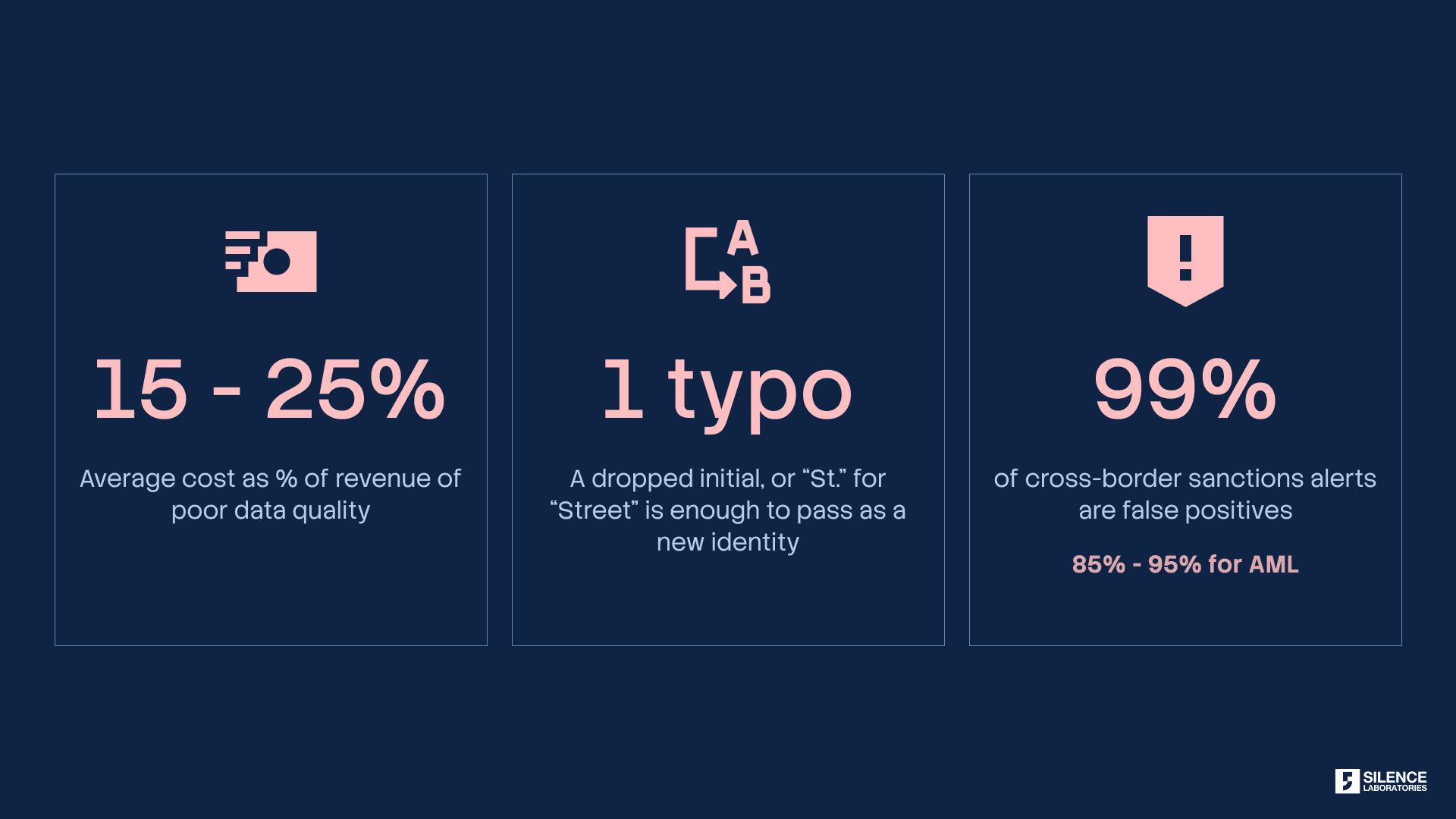
Most "private de-duplication" tools only do exact matching: hash an identifier on each side and compare the hashes. That falls apart the instant the data is imperfect: a middle initial here, a transposed digit there, "Street" vs "St," a maiden name. And for low-entropy attributes like phone numbers or names, hashing is not even private: those hashes can be brute-forced in minutes (https://rainbowphones.silencelaboratories.com/).
Real entity resolution needs rich attributes such as full names, addresses, dates compared with tolerance for typos, aliases, and formatting differences. However, how to standardise such variations without sharing private information across organisations? That tension is what has kept cross-party deduplication stuck.
What we built
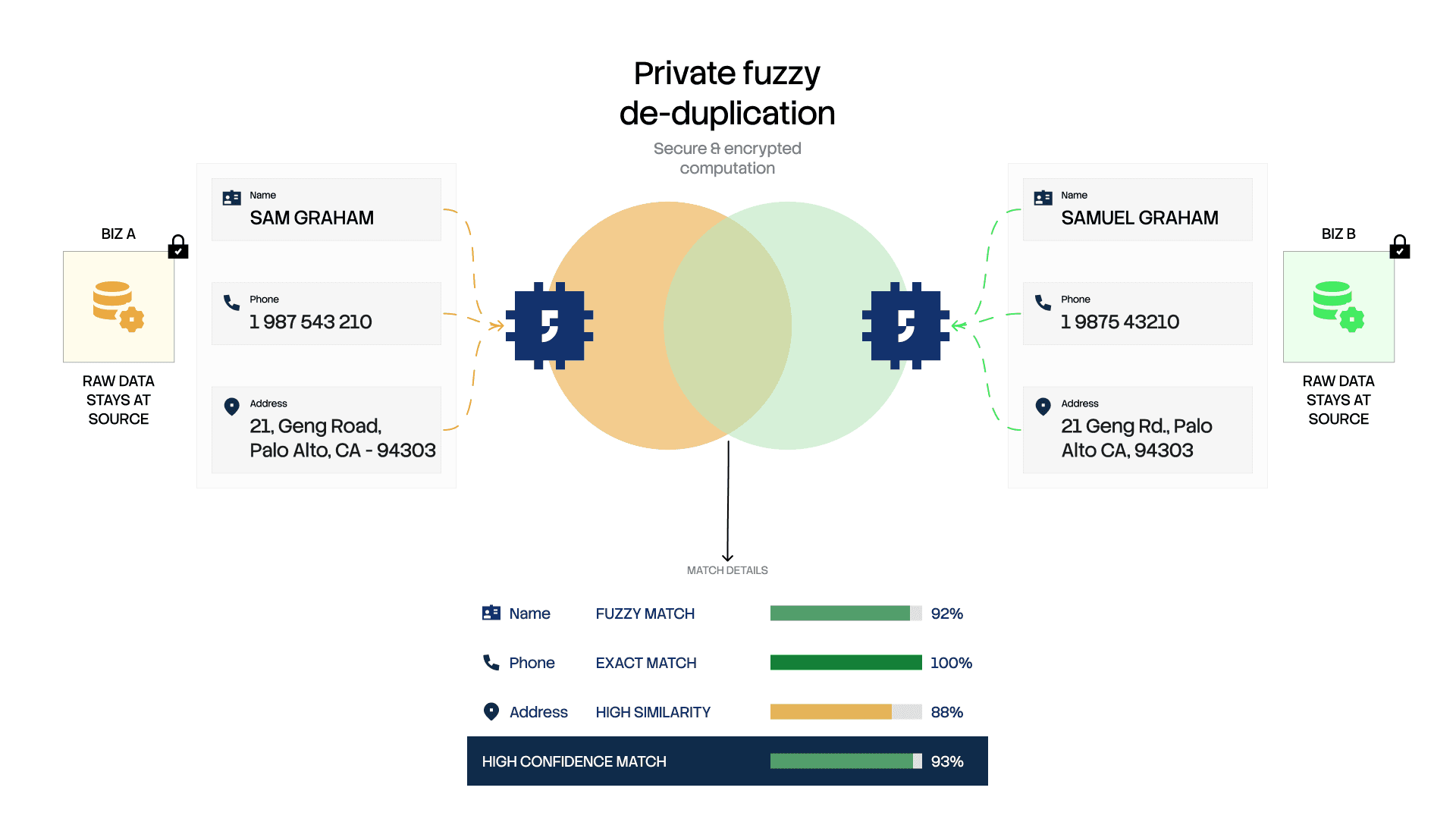
Our Cryptographic Computing Virtual Machine (CCVM), built on Multi-Party Computation and Zero-Knowledge Proofs, now runs probabilistic record linkage over encrypted inputs. Each party's records stay in their own environment. The comparison logic such as string similarity across names, address components, and other fields, executes on encrypted data. Neither party sees the other's records, and Silence Laboratories sees nothing at all: not the inputs, not the intermediate state, not the results. What comes out is only the agreed output - matched clusters, duplicate flags, or match scores - backed by cryptographic proof that only the approved computation ran.
To bring this to production, we’ve partnered with ContexQ, combining their proprietary entity-resolution models that go well beyond off-the-shelf matching with our cryptographic compute engine, to deliver privacy-preserving fuzzy de-duplication & entity resolution end to end.
Powered by Splink
We started from proven frameworks rather than reinventing it. under the hood, this capability is built on Splink, the widely adopted open-source probabilistic linkage engine used by governments and enterprises for entity resolution at scale. Splink’s proven comparison model - fuzzy string similarity, blocking for performance, and calibrated match probabilities rather than brittle yes/no rules - is the same trusted logic teams already know. ContexQ layers its proprietary entity-resolution engineering on top of that foundation, and Silence Laboratories runs the entire pipeline on encrypted data, so the de-duplication happens on data that never leaves its source.
The result is more than the sum of its parts: a battle-tested linkage framework, sharpened by ContexQ’s resolution methods, and delivered with cryptographic privacy guarantee wrapped around it.
Where this unlocks value
Entity resolution and customer 360: Build a single, deduplicated view of a customer across institutions or across siloed systems within one, without centralising PII that becomes a breach liability
Sanctions and watchlist screening: Screen customers and counterparties against sanctions, PEP, and internal watchlists using fuzzy name and address matching, so aliases and spelling variants don't slip through, while the private list and the customer data stay on their respective sides
Duplicate detection in lending: Catch the same borrower, property, or address applying for overlapping mortgages or loans across lenders, a long-standing fraud and exposure risk, through private address and identity matching, without lenders revealing their books to one another
Collaborative fraud and AML: Deduplicate and link identities across a consortium to expose shared bad actors and mule networks, without any participant centralising or disclosing its customer base
Why it matters
Deduplication has always forced a choice: centralise the data and accept the privacy, compliance, and breach risk, or keep it siloed and lose the insight. Privacy-preserving fuzzy de-duplication removes that trade-off. Raw data never moves, regulations around data minimisation and purpose limitation are respected by design, and every computation is verifiable.
If you're currently using Splink or working with entity resolution, screening, or cross-party duplicate detection and privacy has been the blocker, we'd love to have you try our privacy-preserving fuzzy de-duplication.
Reach out at info@silencelaboratories.com or visit silencelaboratories.com.
SHARE


